Showing posts with label Antarctica. Show all posts

Monday, January 26, 2015

At the Mountains of Madness

The cover illustration depicted here has little or nothing to do with this book -- at no point are human characters revealed to be some sort of undead skeleton. However, the image is appropriate -- it shows the horror that can lurk behind the ordinary, the banal, how normalcy can be pulled aside for a terrible revelation.

The story is told in a typical conceit -- as the sole survivor of an Antarctic expedition, the narrator is attempting to warn future explorers against disturbing what he and his companions had.

What Lovecraft is good at is building tension -- things start slowly for the expedition, with exploration and sample taking, until an isolated group makes a discovery "that will do for biology what the work of Einstein did for physics." This, of course, puts the expedition on the path to disaster. The isolated group goes incommunicado, and when a relief expedition arrives, they find the camp in disarray, the men and the dogs wildly slaughtered, and some specimens missing. It's implied, rather than outright stated, that these specimens had lain dormant, rather than dead, and had revived and perpetrated this.

What Lovecraft isn't great at is prose. There's a lot of repetition in terms of "we withheld these details from our reports, but now I must steel myself and reveal the truth," and "ill-prepared we were for dealing with things beyond our ken". It's effective, though, as repetition is a device of madmen, and Lovecraft's protagonists are having the limits of their sanity stretched.

The setting is almost a character in itself, in that Lovecraft spends an enormous amount of time describing the awful city of the creatures, and letting our protagonist read their murals and learn their history. It's very creepy, if a little convenient that a professor of geology is intimately familiar with the Necronomicon and other tropes of Lovecraft's universe.

I would recommend this -- it's not quite what I had expected, and reading works that Lovecraft has influenced makes this lose some of it's power, but it retains enough to remain fresh.

Saturday, October 5, 2013

Vampires in the Lemon Grove

My first impression of the title story in Karen Russell's Vampires in the Lemon Grove was something approaching awe -- this was a novel premise, beautifully executed, well-written. Russell uses the backdrop of vampires who've settled in a small town in Italy to show a couple falling out of love. It's a great story, and probably the best in the collection.

Of the other stories in the collection, "Reeling for the Empire" is nearly as good, and "Proving Up" is truly creepy. "The Seagull Army Descends on Strong Beach, 1979" and "The Graveless Doll of Eric Mutis" are both coming-of-age stories set amidst unsettling conceits. "The Barn at the End of Our Term" seems a little aimless and "Dougbert Shackleton's Rules for Antarctic Tailgating" has its funny moments but doesn't really rise to a point. "The New Veterans" has an interesting premise, but really lags in the middle. And the pre-middle. And the post-middle.

This made me want to seek out more of Karen Russell's work -- she puts her characters in odd environments, gives them fantastic (in the literal sense) stimuli, and in that she almost reminds me of Ray Bradbury.

Tuesday, February 26, 2013

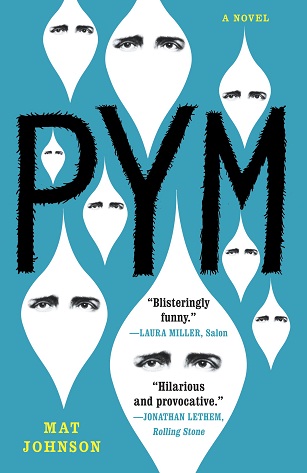
Pym

Mat Johnson's Pym is many things; sure, it's a satirical novel on race in America, both our obsession with it and how it drives American society, but it's also a fun fantasy novel that can be read entirely without context (here, I'm thinking of a sheltered twelve year old, hundreds of years from now, because it's tough of me to conceive of someone reading this and missing the overtones and allusions)

Pym opens with the protagonist, Chris Jaynes, having just been denied tenure at a historically white college in upstate NY (here, I picture something like Bard, or New Paltz) because despite being the sole black male professor, he doesn't behave as he is expected to. That is, he doesn't join the school's diversity committee, and he'd rather teach the whole canon of American literature, rather than just African-American literature.

Immediately after his firing, Jaynes is thrown a bone -- a slave narrative that confirms the truth of Edgar Allen Poe's only novel, The Narrative of Arthur Gordon Pym. Purportedly written by Pym's companion on his voyage, Dirk Peters (the man selling the manuscript interjects, "Who ever heard of a black man named 'Dirk'?", which is a question that could be raised about Jaynes' childhood friend, Garth) the manuscript offers insight into both the mysterious ending of Poe's novel, as well as events leading up to it. Jaynes immediately attempts to venture to Antarctica to confirm, enlisting the help of a his cousin (a marine entrepreneur), and an ex-girlfriend (a lawyer).

When the makeshift crew Jaynes hastily assembles arrives in Antarctica, Pym really hits its stride. With the progression of the plot, the racial satire is ratcheted up, and the parallels with Poe's novel shine through. Pym's progression even includes a similar ambiguous ending.

My edition concludes with sixteen discussion questions, which I'm not going to get into here. I would recommend this novel, even if you haven't read Poe's. While I did, and I thought my experience was enhanced because of this, it isn't strictly necessary.

Tuesday, January 15, 2013

The Narrative of Arthur Gordon Pym of Nantucket


Edgar Allen Poe's only novel can be a bit difficult to digest, despite Poe's limpid prose and straightforward style; it's a novel that swings through genres in a way to render characterizing it as nearly futile. What begins as an adventure at sea becomes horror, a false document, before ending in a kind of mystic symbolism that the heavy-handed notes in my copy chalk up to Poe's grief over the death of his mother and brother. (At left is not my copy, but since I couldn't find the correct image in a suitable size, I just picked what I thought was the best looking image on GIS)

The Narrative of Arthur Gordon Pym of Nantucket (I'm going to leave off its more than one hundred word subtitle (!) here) begins relatively simply: it's the cobbled-together journal of our eponymous protagonist (he didn't keep a proper journal on his adventures, and Poe, among others, supposedly coaxed him to write up his memoirs, as they contain numerous singular anecdotes) Our hero is a young man, living in New England, whose bosom friend convinces him to stow away on his father's brig, which is headed for a voyage to the South Seas. Once a safe distance away from port, our hero is to emerge, when it would be inconvenient to turn back. Of course, fate intervenes, and what had been a simple plan becomes Pym narrowly escaping death over the course of several separate events.

My copy of this work (Penguin Classics. Let no one say I'm highbrow) has a series of (over the top) notes, which mostly amount to calling attention repeatedly to slightly repeated passages, pointing our what source Poe is working from (Pym works heavily with verisimilitude, so he used several real travelogues* as sources for Pym).

* at least one of these has serious questions about its accuracy, in that the author's path would have taken him over the Antarctic continent. So either there are errors of navigation, or . . .

However, three interesting points raised by the notes are 1) that the novel has mirror-like qualities (certain lines occur equidistant from the middle of the book, and the exact middle of the book features two facing mirrors 2) the possible connection of events in the book to Poe's personal life, in that details that may call to mind the life and death of his mother and brother, and 3) the interpretation of the ending. Pym's ending is abrupt and ambiguous: a "note" afterwards explains that Pym died before he could complete his narrative, although he was nearing the end. Since Pym is an invented character, this is clearly not the case, and has led to scholars debating the meaning and symbolism of the ending. As far as Poe goes, this isn't quite a horror story, but it's definitely gripping and worth a look.