Showing posts with label academics. Show all posts

Monday, April 7, 2014

2666

Roberto Bolaño's 2666 is a sprawling epic of a novel. Or rather five novels, linked by common characters, themes, and images. Each section is linked to the previous ones, dealing with events or characters who were previously introduced, whether briefly or in depth. 2666 has twin suns -- Santa Teresa, Mexico (a stand-in for Ciudad Juarez) and Benno von Archimboldi, a reclusive German author, the study of whose work is the focus of the first book of the novel.

2666 opens with an introduction to four critics, and their introduction to Archimboldi's oeuvre. It then explores their work, their travels, their relationships with each other, and Archimboldi's growing recognition; as the critics are introduce to Archimboldi (in the late 70s and early 80s), he's

". . .an utter failure, an author whose books languished on the dustiest shelves in the stores or were remaindered or forgotten in publisher's warehouses before being pulped."
At the end of the section, by the mid-late 90s, he's rumored to be on the short list for the Nobel, as our critics search for him in Santa Teresa, Mexico.

From here, we're introduced to a literature professor assigned to tour the critics around, his daughter, who he fears will be abducted and murdered, like so many other women, an American journalist in town for a boxing match who is fascinated by the murders, various policemen, and in the penultimate section, a hideous, lengthy catalog of the deaths of women, ranging from prepubescent to matronly.

That the fictional city of Santa Teresa is one of the axes 2666 revolves around is true, but Santa Teresa really only has one axes -- the murders. The descriptions of the victims is clinical, repetitive, and horrific in its vast scope. The women are mostly young, in their late teens or early twenties, but we get some girls before the onset of puberty, and those in their thirties, forties, and later. Some of the murders are solved (as to how solved that really is, we don't know), but most are closed when no more information can be found, such as the alleged killer disappears. Perhaps the hardest part of this section is that this isn't a detective novel, where everything will be neatly wrapped up at the end -- people are arrested, and a prominent character is convicted and jailed for some of the murders, but they continue. Other suspects are mentioned, then never dealt with again.

The final section of the novel is an intimate look at the enigmatic Archimboldi, the other axis of 2666. In a somewhat jarring departure from the rest of the novel, where all we learn of him is that his name is probably a pseudonym, and that he's a very tall, very old German writer, the final section follows him from his childhood through his old age, although parts of it are told in a way that echoes Bolaño's other works -- we hear about him not through third person omniscient or limited, but from conversations other characters have about him, while he is elsewhere.

2666 doesn't offer many answers, only questions. I'd bought it a few years ago and held off on reading until I'd read more of Bolaño's work, and I'm glad I did. It's absolutely fascinating.

Sunday, November 17, 2013

A Random Walk Down Wall Street

There's a lot of information in A Random Walk Down Wall Street, but all that information really boils down to "no investment strategy can reliably beat the S&P 500 index over a long period of time." Malkiel provides numerous examples of this, over a time period ending in 1998. (It's too bad that either there isn't an updated edition through the most recent financial crisis, or the edition I have is older.)

Of course, that's not all that's in this book -- there's a history of some famous financial bubbles (Dutch tulips, British East India Company, the US Stock Market in 1929), and a general primer on the various investment vehicles and financial instruments available. The author also includes contact information for various investment houses, which would be much more useful if this book wasn't fifteen years old.

This seems to be a useful primer on the stock market and investing. I don't really know enough about the subject to recommend it unreservedly, but it seems to be worth paging through for a general understanding of the issues.

Tuesday, February 26, 2013

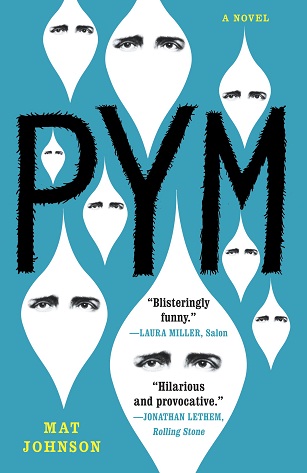
Pym

Mat Johnson's Pym is many things; sure, it's a satirical novel on race in America, both our obsession with it and how it drives American society, but it's also a fun fantasy novel that can be read entirely without context (here, I'm thinking of a sheltered twelve year old, hundreds of years from now, because it's tough of me to conceive of someone reading this and missing the overtones and allusions)

Pym opens with the protagonist, Chris Jaynes, having just been denied tenure at a historically white college in upstate NY (here, I picture something like Bard, or New Paltz) because despite being the sole black male professor, he doesn't behave as he is expected to. That is, he doesn't join the school's diversity committee, and he'd rather teach the whole canon of American literature, rather than just African-American literature.

Immediately after his firing, Jaynes is thrown a bone -- a slave narrative that confirms the truth of Edgar Allen Poe's only novel, The Narrative of Arthur Gordon Pym. Purportedly written by Pym's companion on his voyage, Dirk Peters (the man selling the manuscript interjects, "Who ever heard of a black man named 'Dirk'?", which is a question that could be raised about Jaynes' childhood friend, Garth) the manuscript offers insight into both the mysterious ending of Poe's novel, as well as events leading up to it. Jaynes immediately attempts to venture to Antarctica to confirm, enlisting the help of a his cousin (a marine entrepreneur), and an ex-girlfriend (a lawyer).

When the makeshift crew Jaynes hastily assembles arrives in Antarctica, Pym really hits its stride. With the progression of the plot, the racial satire is ratcheted up, and the parallels with Poe's novel shine through. Pym's progression even includes a similar ambiguous ending.

My edition concludes with sixteen discussion questions, which I'm not going to get into here. I would recommend this novel, even if you haven't read Poe's. While I did, and I thought my experience was enhanced because of this, it isn't strictly necessary.

Saturday, June 12, 2010

Pale Fire

Nabokov's Pale Fire is an oddly structured novel that Jorge Luis Borges would have rendered in a few sentences, as when describing an imagined writer's oeuvre: "He produced a novel containing a 999 line poem in four cantos by a fictional poet, a kind of latter-day Robert Frost, as well as extended commentary by a supposed friend of the poet, who weaves his own, unrelated story into the commentary, and appears to be a madman. It is unclear whether the poet or commentator exist at all (in the world of the narrative), or if one is the invention of the other -- (the poet concocting his own biographer, or the madman dreaming up a poet, to give background to his ravings), or if both are the creation of a third, hidden character."

Careful reading and much scholastic debate seems to confirm that the final hypothesis laid out above is correct, or at least that the commentator (Professor Charles Kinbote) is fictitious. The poet (John Shade) may actually exist in the world of Pale Fire, but the commentator appears to be the invention of a third party, a view endorsed by Nabokov himself. (This raises the interesting question of whether or not we should consider an author's statements outside a piece canonical -- I would say no. I remember a Hemingway story where Hemingway states that a character would kill himself after the events depicted, but, like Kinbote, I'm currently working without a library.)

One of the blurbs on the back of my edition of Pale Fire describes the novel as a "centaur work", which I would disagree with -- while the long poem is clearly essential to the novel, it isn't very good; Shade's Pale Fire, while containing occasional jewels (such as lines 1-4)
I was the shadow of the waxwing slain
By the false azure in the windowpane;
I was the smudge of ashen fluff--and I
Live on, flew on, in the reflected sky.
Is mostly written in conversational verse, much of it addressed to the poet's wife. Perhaps it's part of the joke that a man supposed to be second in stature to Frost among American poets would produce nearly 1000 quotidian lines, but calling this a centaur work is appropriate only if the horse is lame, or the man is mad.

Not that the novel isn't brilliant, because it is -- I read it as a satire of self-important academics, but regardless of Nabokov's intentions, it's pure absurdist fun. Kinbote's bitterness and defensiveness in the Foreword almost reveals his madness, but the slow, subtle progression of his deterioration is masterfully unfolded. Additionally, the Index following the Commentary allows for ease of reference from Note to Note, and reveals details not explicated in the text. While some early reviews criticized Pale Fire as incoherent, I can't agree. While flipping from poem to Commentary broke the verse's rhythm (Kinbote recommends buying two copies and mutilating both to allow for easier reading!), in the case of subpar verse and engaging commentary, I don't think that's cause to complain.