Barbara Holland's Gentlemen's Blood is not quite a comprehensive overview of dueling and its history, but an excellent introductory look at a past custom that we currently look a little askance at.
Holland begins with the duel's origins in the trial by combat, and moves deftly through the centuries (from fencing masters in Italy to swordfighting in France to dueling pistols in England to bloody frontier affairs in the American West, with stops in between in Ireland, the American South, Russia, and Germany, among other places). Given the breadth of the subject matter (dueling was an accepted custom in many cultures, and although it was deplored and illegal at various times, laws against it were very often not enforced), Holland doesn't quite treat the subject exhaustively, but her digressions make this well worth reading. There's plenty of information on how honor was treated (as the currency of polite society), how exactly a duel should be arranged (by the seconds, via a series of notes), the insults most likely to bring about a challenge ("liar" is the most unforgivable, right up with physical violence, which either requires a challenge or renders the aggressor beneath contempt, depending on the culture), and the capabilities of the weapons involved (smoothbore pistols weren't particularly accurate).
There's a lot here, but Holland is most entertaining in her snapshot-like depictions of the many duels, spotlighting combats across countries and centuries. Her eye is sharp, and her wit is acerbic. Highly recommended, it's a quick and entertaining read.
Wednesday, March 20, 2013
Gentlemen's Blood
Labels:
Barbara Holland,
Code Duello,
dueling,
fencing,
flintlock,
honor,
non-fiction,
pistol,
reading,
sabre,
sword
Saturday, March 16, 2013
The Stories of Breece D'J Pancake
Don't judge a book by its cover, or an author by his appellation. I saw "Breece D'J Pancake" and cringed. I figured I knew exactly why someone would choose to do that, and exactly what kind of stories they would write. Luckily, I was way off; from reading the afterword (or one of them, anyway), I learned that the awful punctuation was the fault of the first magazine that published one of Pancake's stories, and he kept it, because why not? Secondly, these stories aren't precious and tedious at all.
The first story in this collection, "Trilobites" is one of the best short stories I've ever read. Some critics, (like Joyce Carol Oates, on the freaking cover of my edition, and at least one of the fore and afterwords) liken Pancake to Hemingway, and while I can see it, I don't think that's wholly accurate. Hemingway is just more sparse than Pancake is -- Hemingway's protagonists seem more detached. The rest of the collection is quite strong, as well. Sure, there are ebbs and flows (the foreword singles out the gothic "Time and Again" as an ebb), but the stories remain inventive and haunting. Recommended unreservedly.
That said, while this is great writing, it isn't always fun reading. These are depressing stories about lost and desperate people, the kind who "have lost a wheel, fallen off a biplane wing, or crossed yourself left-handedly . . .". Pancake doesn't let his characters blur together -- sure, these are miserable people, but they all have very different reasons and circumstances, and he's not going to let you forget that.
The first story in this collection, "Trilobites" is one of the best short stories I've ever read. Some critics, (like Joyce Carol Oates, on the freaking cover of my edition, and at least one of the fore and afterwords) liken Pancake to Hemingway, and while I can see it, I don't think that's wholly accurate. Hemingway is just more sparse than Pancake is -- Hemingway's protagonists seem more detached. The rest of the collection is quite strong, as well. Sure, there are ebbs and flows (the foreword singles out the gothic "Time and Again" as an ebb), but the stories remain inventive and haunting. Recommended unreservedly.
That said, while this is great writing, it isn't always fun reading. These are depressing stories about lost and desperate people, the kind who "have lost a wheel, fallen off a biplane wing, or crossed yourself left-handedly . . .". Pancake doesn't let his characters blur together -- sure, these are miserable people, but they all have very different reasons and circumstances, and he's not going to let you forget that.
Labels:
alcohol,
coal,
despair,
fiction,
hunting,
reading,
short stories,
trilobites,
West Virginia
Tuesday, February 26, 2013
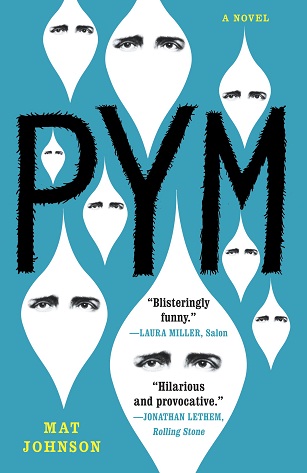
Pym
Mat Johnson's Pym is many things; sure, it's a satirical novel on race in America, both our obsession with it and how it drives American society, but it's also a fun fantasy novel that can be read entirely without context (here, I'm thinking of a sheltered twelve year old, hundreds of years from now, because it's tough of me to conceive of someone reading this and missing the overtones and allusions)
Pym opens with the protagonist, Chris Jaynes, having just been denied tenure at a historically white college in upstate NY (here, I picture something like Bard, or New Paltz) because despite being the sole black male professor, he doesn't behave as he is expected to. That is, he doesn't join the school's diversity committee, and he'd rather teach the whole canon of American literature, rather than just African-American literature.
Immediately after his firing, Jaynes is thrown a bone -- a slave narrative that confirms the truth of Edgar Allen Poe's only novel, The Narrative of Arthur Gordon Pym. Purportedly written by Pym's companion on his voyage, Dirk Peters (the man selling the manuscript interjects, "Who ever heard of a black man named 'Dirk'?", which is a question that could be raised about Jaynes' childhood friend, Garth) the manuscript offers insight into both the mysterious ending of Poe's novel, as well as events leading up to it. Jaynes immediately attempts to venture to Antarctica to confirm, enlisting the help of a his cousin (a marine entrepreneur), and an ex-girlfriend (a lawyer).
When the makeshift crew Jaynes hastily assembles arrives in Antarctica, Pym really hits its stride. With the progression of the plot, the racial satire is ratcheted up, and the parallels with Poe's novel shine through. Pym's progression even includes a similar ambiguous ending.
My edition concludes with sixteen discussion questions, which I'm not going to get into here. I would recommend this novel, even if you haven't read Poe's. While I did, and I thought my experience was enhanced because of this, it isn't strictly necessary.
Pym opens with the protagonist, Chris Jaynes, having just been denied tenure at a historically white college in upstate NY (here, I picture something like Bard, or New Paltz) because despite being the sole black male professor, he doesn't behave as he is expected to. That is, he doesn't join the school's diversity committee, and he'd rather teach the whole canon of American literature, rather than just African-American literature.
Immediately after his firing, Jaynes is thrown a bone -- a slave narrative that confirms the truth of Edgar Allen Poe's only novel, The Narrative of Arthur Gordon Pym. Purportedly written by Pym's companion on his voyage, Dirk Peters (the man selling the manuscript interjects, "Who ever heard of a black man named 'Dirk'?", which is a question that could be raised about Jaynes' childhood friend, Garth) the manuscript offers insight into both the mysterious ending of Poe's novel, as well as events leading up to it. Jaynes immediately attempts to venture to Antarctica to confirm, enlisting the help of a his cousin (a marine entrepreneur), and an ex-girlfriend (a lawyer).
When the makeshift crew Jaynes hastily assembles arrives in Antarctica, Pym really hits its stride. With the progression of the plot, the racial satire is ratcheted up, and the parallels with Poe's novel shine through. Pym's progression even includes a similar ambiguous ending.
My edition concludes with sixteen discussion questions, which I'm not going to get into here. I would recommend this novel, even if you haven't read Poe's. While I did, and I thought my experience was enhanced because of this, it isn't strictly necessary.
Labels:
academics,
Antarctica,
Arthur Gordon Pym,
blubber,
Edgar Allen Poe,
ice,
Lil' Debbie,
Mat Johnson,
painting,
race,
racism,
satire,
Tekeli-li,
Tsalal
Saturday, February 16, 2013
Neuromancer
What can I say about Neuromancer that hasn't been said already? It's one of those novels that nearly any description is going to use either "seminal" or "groundbreaking". Not to say this isn't a good novel -- it is, I'd compare it favorably to any of the sci-fi I'd read recently -- but reading something like this nearly 30 (!) years after it was published, one tends to focus on where the author's vision of the future lacks verisimilitude, rather than where he was eerily prescient.
Despite the above, Neuromancer still retains its power. Worth picking up.
One of the necessary settings in a novel like this is an unpoliced Wild West area, where drugs and technology flow freely, and the opening setting of Chiba City in Japan may be the archetype of that.
The opening setting of Chiba City in Japan, a world of drugs, gangs, nightclubs, arcades, with little to no police presence could be the model for this genre; a Wild West-type area is needed in cyberpunk, and this certainly is it. Our protagonist, Case, is an archetype, too. So is our enforcer, Molly. While the plot may not be too unusual, the overall goal is an interesting one.
Again, Neuromancer is absolutely worthwhile, particularly for its treatment of artificial intelligence.
Despite the above, Neuromancer still retains its power. Worth picking up.
One of the necessary settings in a novel like this is an unpoliced Wild West area, where drugs and technology flow freely, and the opening setting of Chiba City in Japan may be the archetype of that.
The opening setting of Chiba City in Japan, a world of drugs, gangs, nightclubs, arcades, with little to no police presence could be the model for this genre; a Wild West-type area is needed in cyberpunk, and this certainly is it. Our protagonist, Case, is an archetype, too. So is our enforcer, Molly. While the plot may not be too unusual, the overall goal is an interesting one.
Again, Neuromancer is absolutely worthwhile, particularly for its treatment of artificial intelligence.
Labels:
artificial intelligence,
computer,
cyberpunk,
fiction,
hacking,
Japan,
reading,
science fiction,
stimulant,
William Gibson
Thursday, February 14, 2013
The Windup Girl
Paolo Bacigalupi's The Windup Girl reminds me why I love science fiction, I think. It's set a few hundred years in a not totally implausible future, and contains an inventive plot, memorable characters, an immersive setting, and a denouement leaving room for a sequel, if necessary. Unfortunately, the "not totally implausible" future seems almost alarmist on Bacigalupi's part -- "if we're not vigilant, something like this could happen", as opposed to cyberpunk dystopias, which just seem to be, rather than requiring the downward spiral that the world of The Windup Girl does.
Bacigalupi's future Bangkok is richly detailed and imagined. The fruits of genetic engineering are seamlessly integrated without too much exposition, and the future Thai political structure is unfolded slowly, over the course of a few chapters. With a world like this, there's a lot of attention to be paid to setting, and our author does a good job there.
Plot-wise, The Windup Girl skips between several diverse characters working towards different ends. Some of them see the situation more clearly than others, and of course there's some information asymmetry there. The ending isn't totally satisfying, more of a setup to a sequel, but it resolves nearly all the plot threads.
The Windup Girl is a fun, well-plotted science fiction novel. Is that enough to overcome the slight preachiness of the environmental message? Is it possible to write a novel in this setting without having it come across as slightly preachy? Would anyone write a novel in this setting that isn't intended to be preachy? Regardless of the answers to those questions, this is certainly a book worth picking up.
Bacigalupi's future Bangkok is richly detailed and imagined. The fruits of genetic engineering are seamlessly integrated without too much exposition, and the future Thai political structure is unfolded slowly, over the course of a few chapters. With a world like this, there's a lot of attention to be paid to setting, and our author does a good job there.
Plot-wise, The Windup Girl skips between several diverse characters working towards different ends. Some of them see the situation more clearly than others, and of course there's some information asymmetry there. The ending isn't totally satisfying, more of a setup to a sequel, but it resolves nearly all the plot threads.
The Windup Girl is a fun, well-plotted science fiction novel. Is that enough to overcome the slight preachiness of the environmental message? Is it possible to write a novel in this setting without having it come across as slightly preachy? Would anyone write a novel in this setting that isn't intended to be preachy? Regardless of the answers to those questions, this is certainly a book worth picking up.
Monday, February 11, 2013
More than Human
One of the problems of reading groundbreaking works years after they've received their acclaim is that what they brought to the table can seem a little routine. This is unfortunately the case with Theodore Sturgeon's More than Human, which may have seemed revolutionary when it was first published, but now seems like merely a very good science fiction novel.
More than Human isn't a typical sci-fi novel; like Arthur C. Clarke's Childhood's End, it concerns the next phase of human evolution. Like Clarke, Sturgeon focuses on the unlocking of the potential of the human mind -- telepathy, teleportation, telekinesis, mind control, things of that nature. They're very different novels, though, and I would say Clarke's is more interesting in its setup, while Sturgeon's is better in execution.
More than Human is composed of three parts -- "The Fabulous Idiot", "Baby is Three", and "Morality." "Baby is Three" was a previously published novella, and the preceding and anteceding parts were composed solely for the novel. I enjoyed "The Fabulous Idiot" the most, because it's the most straightforward -- the later two can be a little unclear, and demand that a lot of the action happen "offscreen", without necessarily even hinting at the general direction.
There are times when Sturgeon's prose, set pieces, and dialogue seem a little dated, even for something that was written in the 1950s. That said, the concept is novel for the time, and the execution is good.
It's tough to level too much criticism at a novel you've enjoyed, especially when it's critically acclaimed. I don't want to give the impression that this is a bad novel, or something to be avoided. Any reader of fifties sci-fi should absolutely pick it up. It's tough to see this as something that took science fiction into the mainstream, or that took science fiction into the arena of literature, but given the way the subject matter is handled, I can see it if I squint.
More than Human isn't a typical sci-fi novel; like Arthur C. Clarke's Childhood's End, it concerns the next phase of human evolution. Like Clarke, Sturgeon focuses on the unlocking of the potential of the human mind -- telepathy, teleportation, telekinesis, mind control, things of that nature. They're very different novels, though, and I would say Clarke's is more interesting in its setup, while Sturgeon's is better in execution.
More than Human is composed of three parts -- "The Fabulous Idiot", "Baby is Three", and "Morality." "Baby is Three" was a previously published novella, and the preceding and anteceding parts were composed solely for the novel. I enjoyed "The Fabulous Idiot" the most, because it's the most straightforward -- the later two can be a little unclear, and demand that a lot of the action happen "offscreen", without necessarily even hinting at the general direction.
There are times when Sturgeon's prose, set pieces, and dialogue seem a little dated, even for something that was written in the 1950s. That said, the concept is novel for the time, and the execution is good.
It's tough to level too much criticism at a novel you've enjoyed, especially when it's critically acclaimed. I don't want to give the impression that this is a bad novel, or something to be avoided. Any reader of fifties sci-fi should absolutely pick it up. It's tough to see this as something that took science fiction into the mainstream, or that took science fiction into the arena of literature, but given the way the subject matter is handled, I can see it if I squint.
Labels:
evolution,
fiction,
humanity,
reading,
science fiction,
Theodore Sturgeon
Tuesday, January 15, 2013
The Narrative of Arthur Gordon Pym of Nantucket
Edgar Allen Poe's only novel can be a bit difficult to digest, despite Poe's limpid prose and straightforward style; it's a novel that swings through genres in a way to render characterizing it as nearly futile. What begins as an adventure at sea becomes horror, a false document, before ending in a kind of mystic symbolism that the heavy-handed notes in my copy chalk up to Poe's grief over the death of his mother and brother. (At left is not my copy, but since I couldn't find the correct image in a suitable size, I just picked what I thought was the best looking image on GIS)
The Narrative of Arthur Gordon Pym of Nantucket (I'm going to leave off its more than one hundred word subtitle (!) here) begins relatively simply: it's the cobbled-together journal of our eponymous protagonist (he didn't keep a proper journal on his adventures, and Poe, among others, supposedly coaxed him to write up his memoirs, as they contain numerous singular anecdotes) Our hero is a young man, living in New England, whose bosom friend convinces him to stow away on his father's brig, which is headed for a voyage to the South Seas. Once a safe distance away from port, our hero is to emerge, when it would be inconvenient to turn back. Of course, fate intervenes, and what had been a simple plan becomes Pym narrowly escaping death over the course of several separate events.
My copy of this work (Penguin Classics. Let no one say I'm highbrow) has a series of (over the top) notes, which mostly amount to calling attention repeatedly to slightly repeated passages, pointing our what source Poe is working from (Pym works heavily with verisimilitude, so he used several real travelogues* as sources for Pym).
* at least one of these has serious questions about its accuracy, in that the author's path would have taken him over the Antarctic continent. So either there are errors of navigation, or . . .
However, three interesting points raised by the notes are 1) that the novel has mirror-like qualities (certain lines occur equidistant from the middle of the book, and the exact middle of the book features two facing mirrors 2) the possible connection of events in the book to Poe's personal life, in that details that may call to mind the life and death of his mother and brother, and 3) the interpretation of the ending. Pym's ending is abrupt and ambiguous: a "note" afterwards explains that Pym died before he could complete his narrative, although he was nearing the end. Since Pym is an invented character, this is clearly not the case, and has led to scholars debating the meaning and symbolism of the ending. As far as Poe goes, this isn't quite a horror story, but it's definitely gripping and worth a look.
Labels:
Age of Sail,
albatross,
Antarctica,
Edgar Allen Poe,
false document,
fiction,
maritime,
New England,
penguin,
reading
Subscribe to:
Posts (Atom)